Black Friday’s Blessing
Years ago, I befriended an antique dealer by the name of Kerri. My then-lover, Shane, and I first met her at a rummage sale she was hosting, and bought from her a very-nice, old sofa which we took home and painted green. At first, Kerri seemed just as well-structured. In a conversation or two over the phone, she and I discovered that we had a mutual fondness for collecting vintage fabrics (among other things), and, one day, she invited me to the back of her shop to pick through a pile of her textile-outcasts- and to keep whatever I liked.
That sounded good, didn’t it?
But, unfortunately, I didn’t really care for any of them; I took one piece out of politeness. And then she insisted upon piling a few more pieces in my hand, saying, “But look at these! I’d hate to just donate them. Don’t you like these!?”
A bit pushy, but I was used to that.
When these were bagged and securely-dangling off my arm, she led me to a shelf close at the rear of her shop and flung back a sheet that screened a shelf laden with fabrics priced for sale- each marked beyond their value- but jewels of their woven years with potential to tempt! Though I may have drooled, I declined, and kept fast to my thrifty, thrill-seeking method of hunting for happenstance deals for myself from the major charity-shops and tag-sales of the area. She seemed a bit dismayed for my prudence- just for a second. It was then that I should have known.
But I didn’t.
She would call once in awhile, and I started stopping at her shop more-often- more to talk than anything else. As we stood amongst her latest finds, she kept referring to me as one of her best friends, and I was starting to believe it. On one of these occasions, near the noon-hour, her husband (whom I had, by this time, met on several occasions) arrived to ask his wife for lunch. Kerri pleaded with me to watch her shop while they were gone, and sweetened the deal by offering me access to their computer- promptly opening up an internet-browser window for me as she cajoled. Since I didn’t own a computer, I decided that, yes, OK, I had the time. While they were away, only a handful of customers came into the store: they looked around, they picked up objects now and then to set back down; they left. I had no sales to worry about, and no-one needed my help when I offered.
Two long hours later, the couple returned. In the back of my head, I suppose I kept a bit of hope that they would be bringing me a little something- a sandwich perhaps- for my trouble, but nothing was in tow. For in that while, my own hunger had begun to gnaw, you see. I had even found a fascinating web-page with a written introduction to Maharashtrian cuisine. I asked if she would mind printing it for me. She did. I accepted this as reasonable token for her intrusion of my time, sighed perhaps, said my pleasantries and left to find my own lunch.
It might seem obvious to you by now- her nature, and mine, but I was still fool-hardy, and in need of further abuse, it seems. The building I was renting an apartment in was getting a new roof. The landlord decided he couldn’t afford to spend the 60 thou to replace sections of ceramic tile- damaged by the years and seasons, so he had the lot tossed off of the top of that three-story manse to shatter into a dumpster below.
I had long been intrigued by the convolutions and patina of these tiles. I had often found myself gazing at rivulets of water trickling down their crackled glaze as I stood upon my balcony under a steady drizzle. So I asked the workmen if they would mind setting a dozen or so aside for me. Just for keeps. I brought one of these to Kerri, as a gift of interest.
The next day, I noticed a neatly-stacked pile of tiles taking shape next a tree at the side of the parking-lot. “Are you saving these for someone?” From the workman’s description in reply, I discovered new-found admiration for Kerri’s opportunistic savvy! I asked him if he would mind setting 20 more aside for me as well, and then found myself digging into my wallet when he also informed me that Kerri had added honey to her bowl.
And that was fine.
And I wanted no more of them than these, as they do tend to take up space!
I had found an interesting article in an issue of Vogue- the January ‘93 issue, to be exact- in which the eccentric home of two artists in London was examined in exquisite photographs and poetic prose. They lived in what was termed shabby chic– an aesthetic achieved by the use of distressed finds and a permissive attitude toward the decay of objects and their surrounding, aging architecture.
I was fascinated.
I wished I owned the building that I lived in.
Knowing that these pages would surely interest Kerri, I carefully severed them from the magazine, enclosed them in a folder, and brought the folder to her shop.
She promised to handle it with care.
And then I mentioned the state of affairs with the tiles.
She was furious!
She was so absolutely enraged that I had diminished her haul by making a second request to the workmen for more that I had to back myself shock-faced out the door!
I didn’t understand: I lived under those tiles, and she would likely have gotten none of them if I hadn’t called her attention to their looming demise. As it was, she had now to her name many times more than what I had procured…
Obviously, enough wasn’t enough.
It was at this moment that I began to see why Shane disliked Kerri so much. The green sofa was the beginning and end of his dealings with her. Sometimes, he was spot on like that!
A week or so later, she called. She didn’t mention the tiles, and I didn’t ask. Her temperament had returned to her usual, sugary pleasantness. She needed her best-friend-ever to help move some heavy things out of her shop.
Since I already had plans for that night, I politely declined. And I was still shaken from that last onslaught directed at me- can you blame me? I stayed calm, and I also asked if she was done with the article. Apparently, that was not the right thing to say.
“What kind of friend are you?!” was the last I heard as she hung up the phone.
A month later, after I thought things might have quieted, I called to ask again if she would mind returning the folder with the article I had loaned her. No-one answered (which was odd in the evening on a school-night for her children), so I left a brief message at the tone.
Weeks passed.
Years passed.
Her shop closed, and I moved away from the shelter of that once-tiled-but-now-shingled roof.
She never did return that call.
Fourteen years later, I sometimes cringe a bit and seeth as I think of her. Maybe I keep too many things.
I still have the tiles, of course.
About two years ago, I formulated a search on Ebay to replace that missing article.
Last week, I finally got lucky, and today it came in the mail.
I’m out 10 bucks with shipping.
Pennies to heal an old wound.
Afterward: Today, in celebration of sorts, I also did a search of the public court-records for her criminal citations. In the years since that final conversation, her husband filed a restraining order against her for domestic violence, and they no-longer live together; she’s also been sued several times for unpaid debts.
Be wary, dear readers, of people who have uses for you, and nothing else.
Green Thumb (for Beth)
Well…
I just put the cover on some rice to simmer, and thought I’d take a moment to write you with the morning’s revelation…of sorts.
I decided to deal with the problems of our ‘burning-bush’….
Now, it isn’t like the poor thing hasn’t had difficulties in the past. A few years ago, Bob-the-lawn-man talked my mother into allowing him to do some pruning. He promptly lopped off ALL of the lower branches of the ash tree in front- despite my mother asking him only to trim a few, certain branches of a certain limb that were dropping below head-height over the walk-way. And then he attacked the burning-bush: it was about six feet tall at the time, and he flat-topped it down to a two-foot clip-job that any barber might be proud of!
I was aghast. My mother’s mouth quivered when she came home that day; I don’t think she even noticed the freshly-cut lawn.
Needless to say, he hasn’t been allowed to do any pruning since, and I’ve done my best to coax the burning-bush back into shape. But you know such things (as much of gardening) are a test of patience; last year it finally reached a leggy reflection of its former glory.
But this spring, something very unusual has happened: two of the main branches- they both faced the lawn- budded and bloomed along with the rest in the dawn of spring. And little leaves grew from those buds- like the others. And then, they stopped mid-sentence…
…and began to whither and dry. I’ve checked for any sign of disease or pest- there are none. I have never seen such a thing, have you?
The only thing that these two branches had in common were their proximity to the lawn, their closeness to the sidewalk, which makes me wonder. Winter and the wind and Bob played no part- of that I am sure.
So, this morning I cut them off. It is fully a bit over one-third of the plant now missing. And my rice is done now; I will eat it with some dal, of course, as I try to listen to the sound of the wind through the pines- though we have no pines. But it slows my quickening breath.
Spring Cleaning

Dangling cobweb-
Dusty
Brushes a thread-like crack,
Takes a wimpy wipe at the cornice-
Easier to clean than the sky!
And then, in silence,
I’ll sweep.
Salt-Cured Pickles: Part 1
I wanted to think well about what this post should convey, and the reasons for writing it in the first place. This has taken me some time, and I feel very thankful that I still have a following of patient, fellow foodie-bloggers that haven’t given up their hopes for this post, for it is the first in a series of posts that deal exclusively with pickles. But I think they, and any far-future readers, will find the information contained herein and in those future posts informative, and, hopefully, handy.
This past summer, I was pointedly-reminded of the main reason for my writing: I was busy outside, pruning a pair of Japanese yews in our front yard, when a large, dark-blue, pick-up truck pulled into the driveway. In the passenger-seat was an old, old friend that I haven’t seen in at least two years, excitedly waving and shouting to me. Her friend in the driver-seat just sat there, smiling sweetly. Eileen my friend’s name is, and she and I worked together for about nine years, and in that time I brought many, many containers of food from various lands to dine upon during our lunch-breaks (of which, it might be said, we had several during an 8-hour shift). Often I shared what I brought with her (I’m that kind of guy, despite what some might say), sometimes eagerly waiting in anticipation to stimulate her curiosity and to see her reaction to food that most, in our neck of the woods, would consider “out-of-the-box”.
She was a good sport, and already well-acquainted with some perky flavours from her Italian-infused home-town of Kenosha, Wisconsin: giardiniera and peperoncini, anchovies and sun-dried tomatoes. “Here, try this…” was all it usually took on my part, and over time we realized our mutual fondness for anything hot-sour-salty. Certainly, I will never forget discovering the girl who could be happy eating a plain grapefruit, peeling and eating it like an orange. “One grapefruit is too much for one you know, but just right for two…”, and so it went, one or the other of us bringing in a gorgeous specimen, plucked from the grocer’s pile at the height of their sweet-sour, highly-aromatic season- a welcome, sun-like orb in the dreary winter months that we endure- sheer delight! And I’d tear the peel into small pieces to better scent the room; she is a girl who burns incense in her home, after all!
So, of course, on this surprise visit, when all of the catching up and gossip was out of the way, our conversation turned to food. Well…I shouldn’t play it as innocent as that. She asked: “So…what have you been up to lately?”
“Pickling,” I said with a grin. And I divulged my long-meaning intent to drop off a jar or two of my experimenting on her doorstep.
She was more-than-happy with this choice of topic: “I tried some of that “mixed pickle” they serve at Taste of India,” she offered. (Taste of India is the one and only Desi-restaurant in our city, but there are two more- but similar- choices in neighboring Appleton)
“And?” said I with a raised eyebrow.
“Oh! I just had to give some to my sister…it was wonderful: very hot, very sour, salty, and a little sweet; it made my taste-buds wonder what I was doing to them…”
And I think that’s a good way to explain why those who love pickles such as these adore them so much: they are works of gastronomic art in a jar, ready to wake up the taste-buds, teasing and eluding them while they try to discern the subtle flavours present amidst an ocean of salty-sour-and-often-hotly-spicedness. Bliss for those forever seeking new sensations, who often discover fascinating strangers in their gastro-wanderings that become time-honored, comfortable friends that are offered a seat of honour at their tables.
I begin my pickle-prattling with those pickles which I consider salt-cured, drawing your attention to some great recipes that I’ve discovered, and sharing some that I’ve re-worked around new, locally-available ingredients. But first things first: the how and the why:
Salt has been produced and used since ancient times as a food-preservative, and continues to be so highly-revered that it has often found a place in religious rituals. While I have no wish to expound further in detail upon its virtues or history here, it is interesting to note that salt was once the greatest commodity in the formation and relation of world economies, which in turn was a driving force that shaped the world as we know it today.
In my part of the U.S., the practice of salt-curing seasonal foods for year-long use has greatly diminished and is reserved only for certain specialty-foods- such as salt-fish, traditional brined meats, meats prepared for smoke-curing, and specific pickles. Gone are the days when extremely-large crocks- brimming with a years’ supply of salt-cured goodies- were mainstay in larders and cellars. Traces of these times still remain, however, if one were to look hard-enough, but already-decades-old warnings of the health-risks of a diet high in salt, coupled with the birth and subsequent waxing, waning and waxing again of the use of home-prepared, vacuum-sealed canning, as well as the widespread use of refrigeration and freezing devices, have pushed this once-venerated, millennia-spanning method of food preservation into a state of near-oblivion; I think I could walk around my city-block taking a survey, and be fortunate to find one person with the skills to salt-cure anything!
But, fortunately, this isn’t the case with the world as a whole: unreliable, expensive electricity- or lack entirely thereof- carries with it the mixed blessing of a non-reliance upon refrigerators and deep-freezers; the unavailability of factory-churned canning-lids (or rubber-rings) with matching mason-jars makes home-canning a luxury enjoyed by precious few. The old, time-tested methods of sun-drying, salt-curing, and fermenting, doused with oil or not, still work to keep that which is seasonal available for enjoyment throughout the year, and long-held tradition in food-preparation keeps these recipes alive and well. And honestly, these older methods are far-less taxing on the environment and energy-consumption on the whole, and are definitely deserving of the budding revival that I see happening in so-called “first-world” countries.
Personally, I have to admit that I have been mostly unaware of the methods of salt-curing for the greater part of my life. I had eaten and heard of some of these foods that, here, still remain popular, but it wasn’t until I was given a sample of a particular, extremely-delicious, Konkani-style, green-mango pickle, read its accompanying post and recipe, and decided to try it out at home that I realized: this pickle does not ferment- there are no escaping bubbles of gas from bacterial action, it is not cooked and therefore there is no reduction to increase the acidity, nor does it contain a potent acid such as vinegar. So then, how does it work?
And really all I had to do was to look at the Konkani word, nonche…which means that-which-is-salted, or perhaps: that-which-is-salt-preserved, or maybe, more simply: a salt-preserve. I see it translated usually as “pickle”, but, in reality, it refers to a specific type of pickle: one in which salt acts as the main preservative.
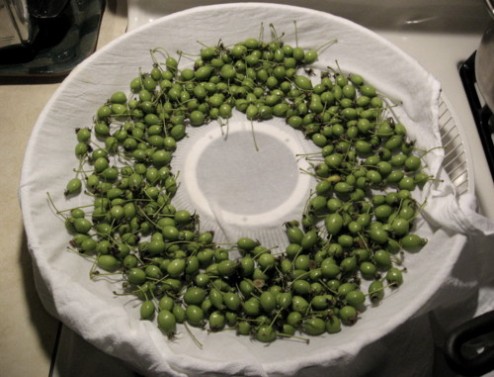
But how much salt is necessary? And, after that: how does one do it? So began my experimenting. I salt-cured nimbu/key limes and Persian limes, Eureka lemons and Meyer lemons, tangerines, oranges, grapefruits, minneolas and kumquats. And then moved on to fresh ginger. And sliced rhubarb. And then I hit upon a real beauty fairly recently: green crab-apples.
You might be scratching your head at that one, but you see, I love sour things. And sour things seem to be often salt-cured in India to become pickles. And “pickle” is beyond method, beyond texture, beyond qualification by anything other than function: world-wide, pickles are eaten in small amounts to enhance a larger meal. But then again, not always…
I have absolutely no complaints about sitting down (or giving a standing ovation) to a meal of pickles, rice and yoghurt. Or pickles with yoghurt-rice. Or sometimes pickles, yoghurt and roti. And sometimes a sandwich smeared with a fine-textured pickle and cream cheese. Variations on a theme: pickle, curdled milk, grains. Where was I? Oh yes, a recipe!
Early this past summer (I do tend to go on and on, don’t I?), about the first of July, I asked Danny, my other half, if he would mind my picking a few green crab-apples from the tree in his yard; of course he didn’t mind, and so I did. I took them home and set to work washing them and trimming the ends. I hadn’t thought ahead of time that “apples are apples” and apples turn brown when cut unless rubbed with a weak acid. Thankfully, I noticed this oversight right away, and dumped measured amounts of salt-cured lime juice into the bowl to halt any further browning (salt-cured lime juice?). And then I added measured amounts of salt to my best guess as to what the little apples would need, for, in salt-curing anything, it is the water-content that is the determining factor of how much salt to use, and this amount is different for different things; you can use more if you like, but there is always a minimum amount required to completely halt the growth of any spoilage-causing micro-organisms like bacteria and fungi. Salt, being a hygroscopic substance, pulls water from the cells of organic tissue by osmosis, rendering it unable to function, and it this action which renders anything salt-cured fairly immortal- if contained in a vessel to protect it from the weather of course. This is why it is very important to not let a single drop of water touch a stash of finished pickle: that one spot will be diluted in salt-content and thus might be able to support unwanted life in the pickle-jar.
But back to the recipe: I placed apples, lime juice and salt in an opaque jar (clear glass will work, but because it lets light through, the colour of your pickle might be faded by light-bleaching. Ceramic jars or crocks with lead-free glaze are the best; not only do they keep light out: they also act as an insulator against fast temperature-changes; plastic tubs will work too, and I often resort to these when I’ve run out of available crockery), covered it with a tight-fitting lid, and set it in a warm place. Does it have to be in the sun? Nope, just warm. I made this pickle in the heat of summer in a room devoid of air-conditioning; in winter I place jars near the heating-vents; you could also set jars in an oven with just the inside light turned on. In times of wavering heat, setting it outside in the sun during the day and bringing it in at night could be the best option. But what is very important is that the pickle is stirred or shaken daily. In fact, I would suggest twice a day for the first week or so, especially if it is a “drier” fruit or vegetable that releases very little water.
There are ways around all of this, of course, by the very clever device of using a dry masala- mixed with salt and surrounding the vegetable or fruit- which simultaneously absorbs and salts the released moisture. With this method, it is best to keep any pieces of that-which-is-to-be-salted submerged beneath the suface, and I still think it’s a good idea to stir the pickle now and then.
Either way, when the vegetable or fruit is tender- some will be ready in as little 12 days, some take longer; much depends on the temperature- the pickle can then be seasoned to your liking (if it hasn’t been done so before), a tadke added if you like, and allowed to sit for a week or so for the flavours to blend, and then enjoyed for as long as it lasts…
But back to my experiment now: I ended up with beautifully-shriveled, little green apples which looked and had a texture very similar to tiny green mangoes. The flavour was different, of course: crab-apples have spice-like overtones which, if you have never had them, can be a treat! My grandmother made sweet pickles of ripe crab-apples yearly, and I was raised seeing a bowlful of them- stems kept intact for easy plucking- at certain meals that she judged worthy of their presence. Because they are a small fruit, there is a lot of work involved to produce a quartful, therefore, pickled by whatever method, they are a labour of love.
And then I thought: what better way to crown this success of mine than by referring back to that recipe which first enlightened me? I love its masala: it is chile-hot and hing-y, and has the subtle, lightly-roasted flavour of mustard-seeds, and an even-more-subtle touch of pleasant bitterness from a few methi-seeds. Simple, yes, but it has a special brightness and “ring” in its flavour of which I have become most fond! So, I borrowed Mrs. Varada’s masala for kochle nonche and placed it here, with my gatherings of summer. But it doesn’t stop there.
Anita of A Mad tea Party was also quite helpful- in many ways- in my strive to prepare good pickles. She uses a special technique to roast the spices for her Rajasthani-style, green-chilli pickle- wherein she heats oil and adds it into a bowl of ground masala. I have found that by adjusting the amount of hot oil that you add, one can also control the roast of the spices: more oil=more heat=darker roast. And I have also discovered that it is not a good idea to do the vice-versa: never add a large amount of dry masala to a large amount of oil (for larger batches of pickles); apparantly, it can froth and foam and escape your pan onto your stovetop! 🙂 For this pickle, a very light roast is indicated, retaining a hint of the brightness of the raw spices and yet subdued and gilded.
Varadian Salt-Cured Crab-Apples
5 C green crab-apples (pick when plump, but seeds are undeveloped- July 1st for my area)
1 1/2 C lime juice
3/4 C salt (this is 5t per cup of green crab-apples, 7 t per cup of lime juice; use more if you like, but not less)
1/4 C oil (raw sesame/gingelly oil preferred, but any mild-flavoured oil is fine)
5 T mustard seeds
3 3/4 t methi seeds
5 pea-size pieces of pure hing
1 1/4 C red chile powder
1) Wash and trim ends (and any spots) of the crab-apples and place in a jar along with the salt and lime juice; mix once-in-a-while as you go. Cover the jar tightly, and place in a warm spot for about 12-14 days; stir or shake the contents of the jar twice daily until the crab-apples are shriveled and tender.
2) Grind the mustard seeds, methi-seeds and hing to a powder; place this in a small steel bowl; heat the oil smoking-hot, remove from heat and spoon/pour it carefully over the ground spices, and stir well with a steel spoon; allow to cool.(Using a stainless steel bowl allows the mixture to cool rapidly and maintain control over the roast. If you decide that you would like more oil in this pickle, heat all of the oil together to smoking, but use only 1/4 C to pour over the spices- allow the rest to cool and add afterward)
3) Mix well in a bowl the oily spices with the ground red chiles; mix this masala into the salt-cured crab-apples and allow to age at least another week before using (3 more weeks is best), stirring once every few days.
4) Enjoy in small amounts with rice and a little ghee, or, for a truly-memorable flavour, with curd-rice! And yes, I would even bring a bowl of this (pre-mixed) to a party! In fact, I think I will…
Thank you so much, Mrs. Varada and Shilpa, for sharing; and to Anita for all of your help and patience.
And, oh! Happy 3rd anniversary to AMTP! This will work I hope? All I have to do is make some rice and open a jar…
A Jar of This, a Jar of That…

…and patience. Throughout life it can reward one with many wonderful things: a good harvest from the tender care of plants… bright, kind and thoughtful children… a materialization of a well-planned design…great talent and skill nudged forth by an undying interest….a post on a blog…
…and pickles. Yes.
Over the last few months, I’ve been more-than-hinting to a few of you what I’ve been up to. The thing is: the more research and “clinical studies” I did, the more recipes I stumbled across- some of which totally made me re-write any rules I had by then formulated in my head, and I found that the subject of Desi pickles couldn’t be so easily-contained within a single post. I also found that I knew much less- next to nothing- about them, despite my great curiosity and passion for them.
Seemingly, within the borders of its myriad cuisines, India sports an absolutely bewildering array of preserves, and uses every method known to humankind to achieve the end of food immortality. At first I concluded that some of these methods were peculiar to India, but in my unquenchable, tongue-driven quest for ever-new sour-saltiness, I made brief sojourns (forced, of course) into the documents of other lands’ cuisines, and found kinship there. I became keenly aware that the allegorical pickle jar of the world is very large indeed, but salt and sour seem to be the ties that bind- to keep things safe from the harms of time. The jars are just silent hands.
But how grand!


 Elaichi et Cetera...